
Thoughts, highlights and stories from the week:
(1) Speak freely from the heart ❤️. Most know when it's real and when it's not.
(2) What are you going to do after you lose? That's the difference between a champion and an ordinary fighter.
(3) Don't do your best. Do what it takes!
(4) Be the only, not the best.
Kevin Kelly has an idea I love: live your most improbable life.
His argument is simple. AI runs on the predictable. It's trained to produce the most likely answer. So the more predictable you are, the easier you are to replace. The way to stay irreplaceable is to become a one-off: a unique mix of talents, experiences and interests that carves out a niche nobody else occupies.
Or, in his words: "You are not the best, you are the ONLY."
So here's the play: let the machines handle the predictable parts of your work, done the way you'd do them. Think of AI as a chief of staff keeping you on top of your responsibilities, so your mind is free for the work only you can do.
→ In sales: you're in meetings and on calls, while AI handles follow-up emails and CRM updates.
→ As a doctor: you're talking to patients, while AI analyses their reports.
→ As a teacher: you're mentoring students, while AI grades and builds lesson plans.
→ As a founder: you're with customers, your team and the people you want to hire, while AI screens candidates, schedules interviews and preps the board deck.
→ As a writer: you're finding your angle, while AI handles research and formatting.
And don't worry about being original from scratch. Borrow constantly. As Austin Kleon argues in Steal Like an Artist, your curation is already unique, because no one else has your exact mix of obsessions. Even what you copy comes out with your fingerprints on it.
Don't compete with the machines on efficiency. Compete on being you.
(5) Save aggressively to make BIG bets
In business and in life, you get a limited number of years and a limited amount of money. You can't swing at everything.
Warren Buffett's version of this: imagine you get a punch card with only 20 punches for your entire life. Every big decision uses one. You'd think much harder about each one, and you'd only need a few to be right.
Or as he puts it: "You don't have to swing at everything — you can wait for your pitch."
Munger added the hard part: the money isn't made in the buying and selling. It's made in the waiting.
Savings aren't idle money. They're the bat on your shoulder.
So wait for the fat pitch. And when it comes, swing hard.
(6) Do AI tools negatively affect your ability to think? Research shows that it obviously does.
This is from an email I received from Cal Newport, someone I'm subscribed to. I find it super exciting to use AI to create space for the most important tasks. But the ultimate thinking and processing has to happen inside our head.
Here is Cal:
”A new research paper titled “AI Assistance Reduces Persistence and Hurts Independent Performance,” which was recently presented at the Conference on Language Modeling, has been attracting attention.
It explores an obvious question: do AI tools negatively affect your ability to think? It does so with a simple experimental design: participants were divided into two groups tasked with solving a series of math problems involving fractions. One group had to find answers on their own, while the other used ChatGPT to help.
At first, the ChatGPT group performed better, which is not surprising because LLMs are good at solving math problems. But then the researchers turned off the chatbot. Not only did the AI group’s accuracy fall below the control group, but many participants in the AI group gave up and started skipping questions altogether.
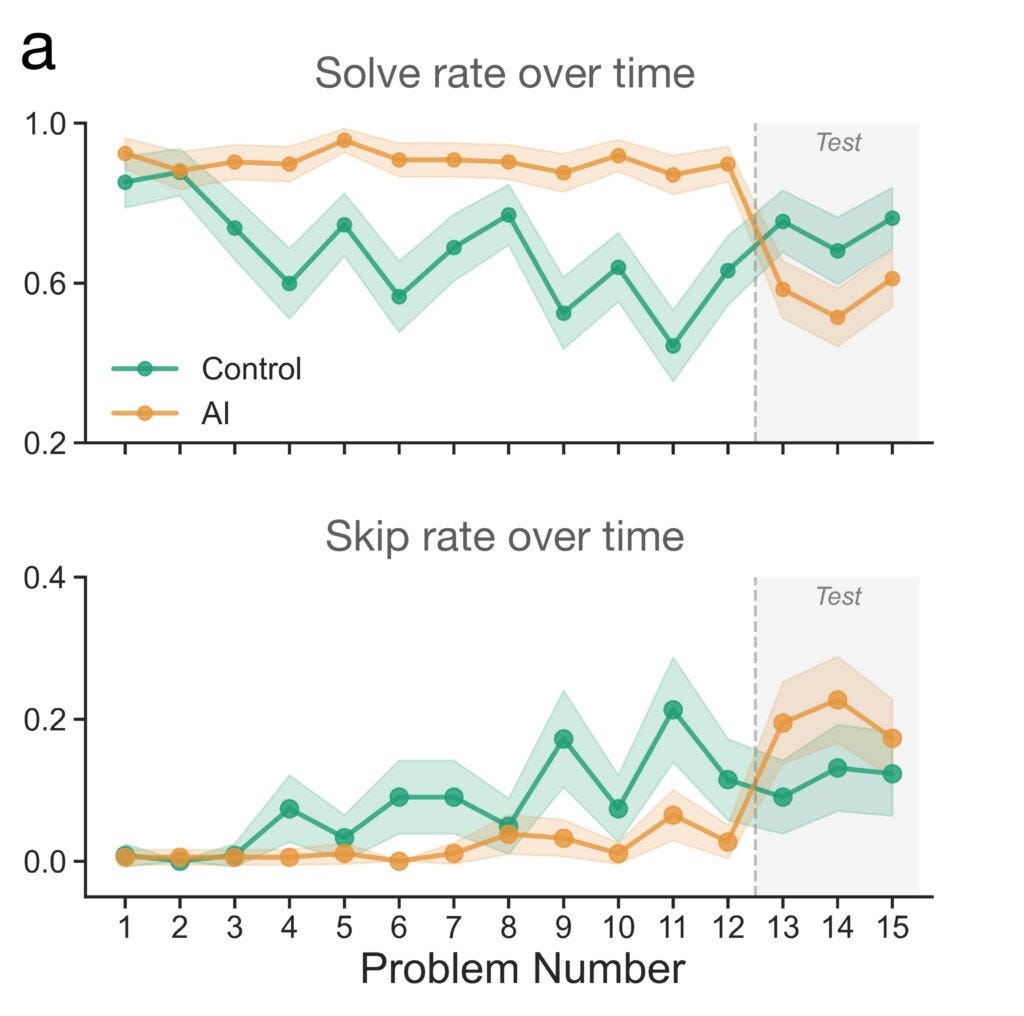
The researchers repeated the same experiment several more times, including one instance where math problems were replaced with an SAT reading comprehension prompt. They kept finding the same drop-offs in accuracy and persistence.
Here’s how a press release about the paper summarized these results:
“The findings backed up what anecdotes and surveys have increasingly found in recent years: An overreliance on AI for answers erodes our cognitive fitness. When AI produces answers in seconds, we get used to that speed; anything that takes longer feels inefficient.”
Brian Christian, one of the paper’s authors, put it plainly: “You almost couldn’t ask for a clearer story.”
I’ve spent the last decade thinking and writing about how technologies might accidentally degrade our cognitive fitness, and how this might in turn degrade not only our economic productivity, but also the quality of the human experience more generally.
In this sense, these LLM findings aren’t revealing something new.
What is new, however, is the jaw-dropping speed of these impacts. We’re accustomed to slow-moving techno-cognition trends such as the negative effects of ubiquitous smartphone usage — which took years to emerge in the data.
With chatbots, the negative impact is immediate. The high generated by side-stepping mental effort using LLMs is so compelling that, with only a short exposure, hard thinking quickly becomes intolerable.
The good news is that we don’t yet know if these effects are permanent. Presumably, the research participants who struggled immediately after ChatGPT was turned off might do much better on the same type of test if they tried again later in a setting where AI help was clearly not an option.
But we cannot ignore the warnings that these early studies are generating. When it comes to our cognitive fitness, we’re playing with a powerful new force that we don’t yet fully understand.
A key theme of my work in the technology critic space is that a life without serious, sustained, intentional thought is impoverished. Thinking is how we make sense of ourselves and the world, and is how we imagine new horizons and create the key elements of our future. It’s at the heart of philosophy, theology, and human empathy; the ability that separates our species from all other animals.
Silicon Valley is good at creating tools, but terrible at figuring out how we should use them. The latter step is still up to us — but it requires us to care.”
Harsh

I spent sixteen years helping build a business till it sold. Now I'm helping build something much bigger. I share what I learn on WhatsApp, LinkedIn, and this Sunday Email.