

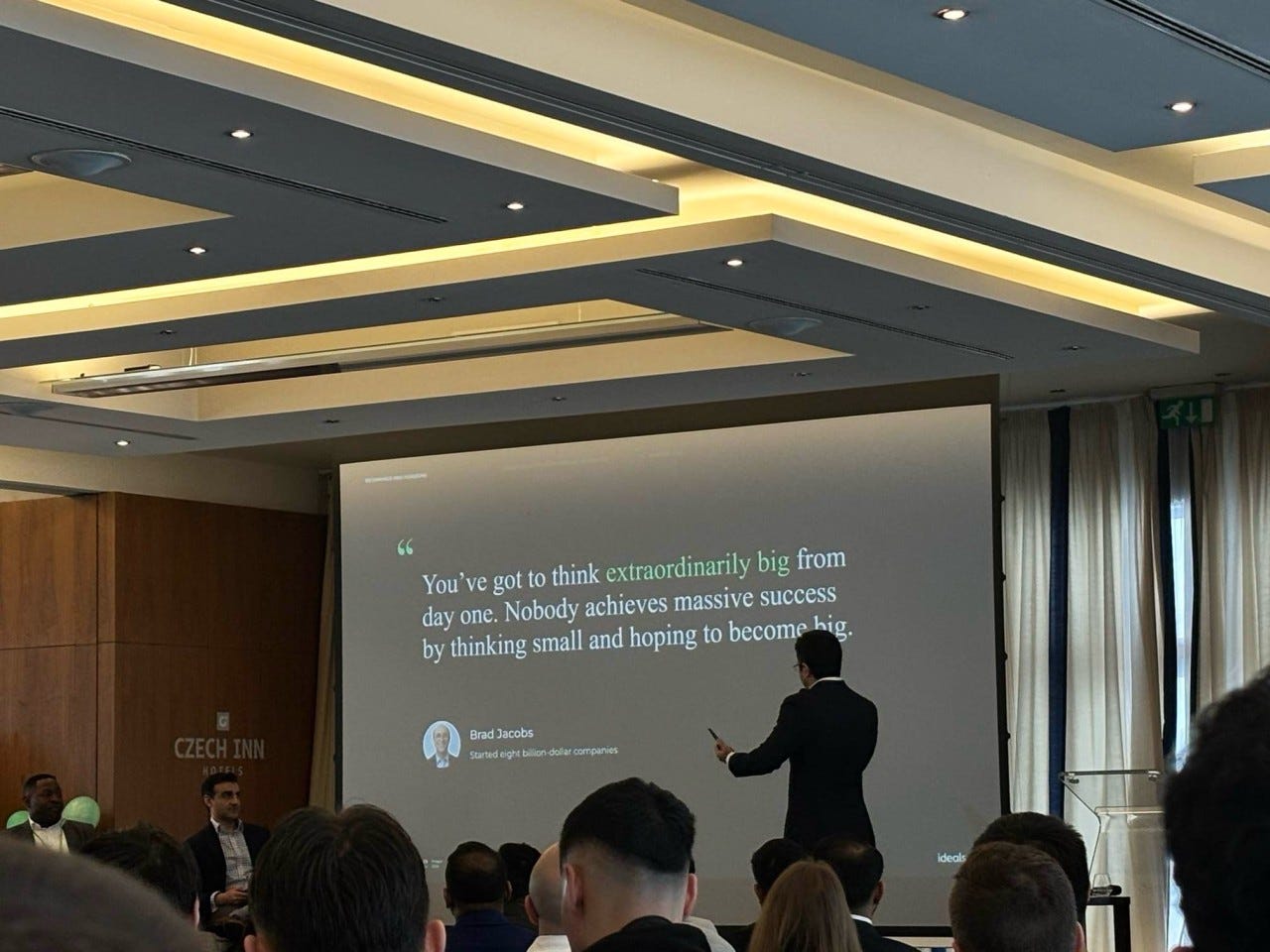
I gave a presentation last week on how far we have come and how far we will go.
It was our Sales Kick-Off. I wanted to inspire everyone in the business — my team and the global organization. I did this by sharing my personal journey, backing it up with hard numbers, and spotlighting the incredible people who made it possible.
My main message was clear: If I can do it, you can do it. But to do it, you need to think big and believe before you can achieve.
Over the next four days, I had colleagues from every department approach me to share the impact the talk had on them.
“Harsh, after listening to you, I want to join sales.”
“I journaled after your talk and it unlocked a different mindset in me.”
“Your story was the highlight of the day. You had every single person paying attention to each word you said.”
“I have no doubt that we will do incredibly well after hearing you speak. You made me feel lucky to be in the right place at the right time.”
“Can you please share your presentation because I’d like to revisit it when I feel in doubt.”
All in all, around twenty colleagues came to me with unsolicited, positive remarks. It felt good to have such an impact.
But then came some negative remarks.
I heard that the very things which inspired so many were seen by a few as selfish, authoritarian, and negative. That my style went against the culture of the company. This upset me initially. But after soliciting advice, I realized a fundamental truth: How someone interprets the world depends on the lens through which they see you.
Here is the perfect example:
When I stepped onto the stage, I was nervous. I had two hands, but three things to hold: my phone (for speaker notes), the mic, and the clicker. So, I requested a colleague — who had just presented for North America — to help me click through the slides. He happily obliged.
Later, I was told that someone viewed this logistical act as a “power move.” She felt I was putting him down by making him click my slides.
In my mind, it couldn’t have been further from the truth. I would have done the same for him. But it was a stark reminder of how the exact same act can lead to two wildly different interpretations based on the observer’s bias.
Draw a line in the sand
This whole experience reminded me of a chapter I read in Rework. It said that if you want to stand for something, you have to draw a line in the sand.
Once you stand for something, there will always be people on the other side of the line who disagree with you. They may not like your style, your personality, your message, or your energy. And that dislike will manifest as them finding fault in what you do.
When you reach this stage, it means you are actually making a difference.
Weighing the overwhelmingly positive response against the pocket of negative feedback, I concluded that I made an impact. If I have to take some flak to create that kind of mindset shift in so many people, it is worth it.
I drew a line in the sand.
“I heard you. Thank you for sharing.”
The person who told me the “power move” story also gave me great advice on how to respond to those who come at you with negativity.
She said, “Some people just want to be heard. So the best thing to do, even when you hear something destructive instead of constructive, is to simply listen and say: ‘I heard you. Thank you for sharing.’“
Then, you decide what to do with that information. Sometimes it will be nothing. Sometimes it may be something. Either way, you respond with equanimity.
For example, a colleague came up to me and said “I’ve heard that you like attention. Be careful.”
I did not understand the point of her remark so I said “I don't understand. Can you please be specific.”
She replied “I wasn't there for your presentation but I heard that you like attention. Be careful.”
I walked away perplexed. But I realize that logic doesn't work in that situation. Her message wasn't about the presentation - she hadn't even seen it. It was about me.
The best response would have been a smile and “I heard you. Thank you for sharing.”
Meaning + Challenge + Impact
So why do I keep pushing when it attracts criticism? Why do I not just “blend in” and become “unseen”?
When the CEO was speaking before me, he was asked - “What keeps you going? Why keep working when you have already reached a certain level of success?”
He said that when he evaluates his work, he looks for three things: Meaning, Challenge, and Impact. This resonated with me.
Meaning: Do I believe in what we are building? Yes.
Challenge: Is the goal of 4x growth hard? Absolutely.
Impact: Will achieving this positively impact the lives of my team and myself? Without a doubt.
So when you filter your life through that lens, you stop worrying about the noise.
Don’t be afraid to go all-in
“If you’re going to chase a dream, go all in.
If you’re going to love, love fiercely.
If you’re going to walk away, never look back.
So many people never give themselves a fighting chance because they never fully commit.
If you’re gonna go, go all the way. No half measures.” — Alex Hormozi
I am all-in on everything I do. You will feel my belief in my tone, in my body language, in my words, and in every action I take.
Because if I do not believe in myself and if I do not voice those beliefs, I can never act in ways that make those beliefs possible, for myself or my colleagues.
So next time, do not say – “I will try my best.”
That phrase leaves a door open for failure in your mind.
Say – “I will do it.”
Failure is still possible, but in your mind, you have burned the bridges to retreat. You have to make it happen – and you will.
See you next Sunday.

👋 I’m Harsh. I collect useful ideas to win in business and life.
Here’s where I spend most of my time:
iDeals Virtual Data Rooms – building a $1B business by helping dealmakers close deals faster
M&A Community – uncovering personal stories and strategies of M&A, private equity, and investment banking leaders
Happy Ratio – growing a food company the hard way: profit-first, purpose-led
Marcellus Investment Managers – evangelizing long-term investing to build financial independence
Harsh Batra
(LinkedIn)